
A no-fluff, no-jargon guide to professional tree services in Sydney — from a bloke who’s seen what happens when you ignore the gum tree leaning over your roof.
There’s a particular kind of Sydney homeowner who notices the enormous scribbly gum near their back fence every single morning — and every single morning, thinks, “Yeah, I should probably get someone to look at that.”
Then storm season arrives. The neighbours get a new car. And suddenly that “probably” becomes a very expensive “definitely.”
Sound familiar? You’re not alone. Across the North Shore, Northern Beaches, and wider Sydney basin, thousands of properties sit under trees that range from perfectly healthy and beautifully maintained, to genuinely terrifying ticking timber clocks. The difference between those two outcomes almost always comes down to one thing: getting a certified arborist involved before the drama starts, not after.
This guide covers everything you actually want to know — what professional tree services involve, why they cost what they cost, when you need a crane (and why that’s actually a good thing), and how to pick a team that won’t leave your garden looking like a crime scene.
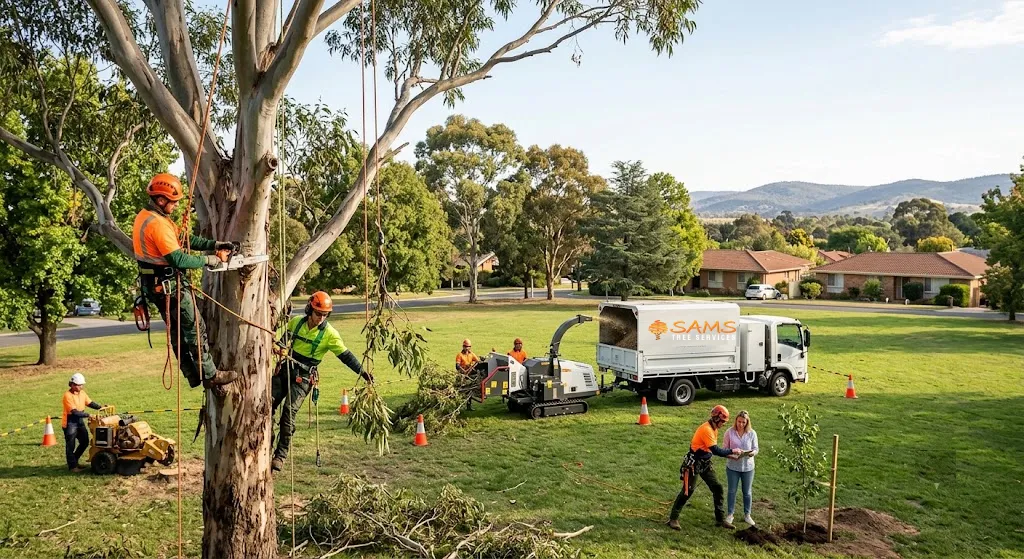
Wait — What Even Is a “Tree Service”? (And Why It’s More Than Just Chopping Things Down)
When most people Google “affordable tree services Sydney,” they’ve got one image in mind: bloke with a chainsaw, tree gone, done. And yes, removal is part of the picture. But professional tree care in 2025 is genuinely a science, not just a trade.
A qualified arborist — and qualified is the key word here — is trained to assess tree health, structural integrity, root system behaviour, disease progression, species-specific growth patterns, and the biomechanical forces that govern how a tree will fall if it fails. They work to Australian Standard AS 4373. They carry public liability insurance. They know what your council will and won’t approve under a tree preservation order.
The full suite of professional tree services typically covers:
Tree Removal — The big one. Whether it’s dead, diseased, dangerously positioned, or just where you want to build your new deck, removal needs to be done safely with proper rigging, sectional dismantling, and controlled lowering. No “she’ll be right, I’ll just push it over.”
Tree Pruning and Lopping — Done properly, pruning extends a tree’s life, improves its structural strength, and reduces the load that can turn a storm into a disaster. Done badly (hello, “hat-racking”), it permanently damages the tree and often voids your public liability protection if something later falls.
Arboriculture Maintenance — Think of this as preventative tree healthcare. Regular inspections, canopy thinning, deadwooding, formative pruning for younger trees. The boring-sounding stuff that quietly saves you $8,000 five years from now.
Stump Grinding — Because nobody actually wants a tripping hazard in their lawn that’s also harbouring termites, thank you very much.
Mulching and Wood Chipping — Turning the removed material into something useful for your garden, rather than paying to truck it all away.
Each of these services exists for a reason. The trick is knowing which one your situation actually calls for — which is exactly why you start with a professional assessment, not a YouTube tutorial.
“Do I Actually Need a Certified Arborist, or Can I Just Hire Anyone?”
Fantastic question, and the answer is: it depends entirely on how much you like your roof, your car, your fence, and your neighbour’s goodwill.
Here’s the honest reality of the Sydney tree services market: it’s unregulated at entry level. Anyone can buy a chainsaw, print some business cards, and start taking jobs. Some of these operators are skilled and careful. Others… are not.
A certified arborist in Sydney has completed, at minimum, a Certificate III in Arboriculture (AQF Level 3). More experienced practitioners hold Level 5 qualifications. They’re trained in risk assessment, proper cutting techniques, safe rigging and lowering systems, and tree biology. When you hire a certified professional, you’re not just paying for someone to hold a chainsaw — you’re paying for:
- A proper risk assessment before any cut is made
- Knowledge of your council’s tree preservation orders and whether you need a permit
- Correct insurance that actually covers the work being done
- Techniques that won’t structurally compromise neighbouring trees
- Legally valid arborist reports for development applications
The gap between a qualified professional and a “cheap quote from Facebook” becomes very apparent when something goes wrong. And in tree work, things going wrong can mean a 15-metre eucalypt through someone’s bedroom.
Sam’s Tree Services operates with fully qualified arborists and comprehensive public liability coverage on every job — not just some of them.
The Process: What Actually Happens When You Book Professional Tree Services in Sydney
A lot of people don’t book because they don’t know what to expect. So here it is, start to finish.
- Initial Assessment and Quote
A professional arborist will visit the site, assess the tree(s) in question, identify any risks or constraints (nearby structures, underground services, overhead power lines, root system concerns), and discuss your goals. You’ll receive a clear, itemised quote — not a vague ballpark over the phone.
For complex or large jobs, this assessment phase is genuinely important. A tree that looks simple from the footpath might have a root system tangled through your drainage, or a trunk that’s hollow on one side. You won’t know until someone qualified has a proper look.
- Council and Permit Checks
Sydney councils take tree protection seriously — some frustratingly so. Many trees over a certain height or trunk diameter require council approval before any work can be done, even on private property. A good arborist knows this, handles the paperwork, and won’t start work until everything is above board. This protects you from fines that can run into thousands of dollars.
- Site Preparation and Safety Setup
Before any cutting begins: the work zone is established, the public is protected, and the removal method is confirmed. For straightforward jobs, this might be simple exclusion zones. For complex work near structures, it involves rigging systems, drop zones, and — when needed — crane setup.
- The Actual Work
Depending on the job, this might be:
- Ground-level felling for open-space trees with a clear drop zone
- Sectional dismantling for trees close to structures, where limbs are rigged and lowered piece by piece
- Crane-assisted removal for large trees in confined spaces where neither felling nor standard sectional work is safe or practical
We’ll talk more about crane work shortly, because it’s genuinely fascinating and also often the most misunderstood service in tree care.
- Site Cleanup and Debris Removal
A professional crew leaves your property in better condition than they found it. Green waste and timber are chipped, removed, or — if you want it — turned into mulch for your garden. No debris piles sitting on your lawn for three weeks.
- Follow-Up Recommendations
If your arborist notices other trees on your property that need attention — signs of disease, structural concerns, root issues — they’ll flag it. This isn’t upselling; it’s genuinely what you want to know before a problem escalates.
Let’s Talk About Crane-Assisted Tree Removal — Sydney’s Most Underrated Tree Service
Here’s the situation that comes up more often than you’d think: there’s a massive tree — a 20-metre Sydney blue gum, maybe, or a sprawling Moreton Bay fig — wedged between a house, a pool, and a side fence that’s exactly 80cm wide. There’s no way to fell it. There’s no space to safely lower sections with ropes alone. The neighbours are watching nervously.
This is where crane and tower specialists earn every dollar of their quote.
What is crane-assisted tree removal?
Exactly what it sounds like: a crane is used to lift and extract sections of the tree — or in some cases, the entire tree — from the site. The crane holds the load while the arborist cuts, eliminating the risk of an uncontrolled fall onto structures below.
When is it used?
- Large trees in restricted access situations (narrow side gates, completely enclosed rear yards)
- Trees directly over buildings, pools, vehicles, or power infrastructure
- Situations where a tree has already partially failed and can’t be safely climbed or rigged from below
- Jobs where ground disturbance needs to be minimised (e.g., over a concrete driveway that nobody wants cracked by a falling trunk section)
What are the benefits?
The obvious one is safety — for your property, for the crew, and for your neighbours’ sanity. But there are others: crane work is often faster than extended manual sectional dismantling, which means less time with workers on your property and lower overall labour costs on complex jobs. The precision of crane extraction also means cleaner cuts and better management of where debris lands.
It’s not the cheapest option, but on the right job, it’s the right option — and a good arborist will tell you honestly whether your situation genuinely warrants it or whether it can be handled another way.
Commercial Properties: Why Your Trees Are a Liability You Might Be Ignoring
Residential tree work is important. Commercial property tree management is critical — and dramatically underinvested in across Sydney.
If you manage a commercial property, strata complex, council facility, school, or any other site with trees and public foot traffic, your duty of care extends to those trees. A branch that falls on a pedestrian isn’t just a tragedy — it’s a significant legal and financial exposure if it can be shown that the tree’s condition was known (or should have been known) and wasn’t addressed.
Commercial property tree services operate differently from residential work in a few key ways:
Scale and scheduling — Commercial sites often have multiple trees requiring different types of work, and the job needs to be coordinated around business hours, public access, and site logistics.
Documentation and compliance — Commercial operators need proper arborist reports, risk assessments, and records of maintenance for insurance and legal purposes. This isn’t optional.
Ongoing maintenance programs — Rather than one-off emergency callouts, smart commercial property managers establish regular maintenance schedules. Annual or biannual inspections, programmed pruning cycles, proactive hazard assessments. It’s the difference between managing your green assets and reacting to them.
Aesthetic and brand considerations — The trees around a commercial building are part of its presentation. Well-maintained, professionally shaped trees signal that a property is cared for. Overgrown, poorly maintained trees signal the opposite.
If you manage a commercial property and you don’t have a documented tree maintenance program in place, it’s worth having a conversation about what that might look like.
Why “Affordable Tree Services Sydney” Doesn’t Have to Mean Cheap and Nasty
There’s a real misconception baked into the phrase “affordable tree services” — that affordable means cutting corners, using underqualified workers, or hoping nothing goes wrong.
Done right, affordable professional tree services in Sydney just means transparent, fair pricing with no hidden costs, no upselling work that doesn’t need doing, and a crew that respects both your property and your budget.
The way to get genuinely affordable tree services — as opposed to cheap ones that cost you more later — is:
Get multiple quotes, but compare properly. The lowest quote isn’t automatically the best value. Check what’s included: does it cover all debris removal? Stump grinding? Insurance documentation? A quote that seems $200 cheaper might be $500 more expensive once you factor in what’s missing.
Invest in maintenance before you need emergency work. Emergency tree removal after storm damage — when there’s a time-sensitive hazard and you need someone there immediately — costs significantly more than scheduled work. Regular arboricultural maintenance catches problems before they become emergencies.
Hire qualified professionals from the start. We’ve covered this, but it bears repeating: the cost of redoing bad tree work, repairing property damage from an uncontrolled fall, or fighting a council fine for unpermitted removal is almost always higher than hiring a certified arborist the first time.
Ask about seasonal availability. Like most trades, tree services have peak periods (post-storm, pre-summer). Booking work in shoulder periods — late autumn, winter — often means better availability and more competitive pricing.
Sam’s Tree Services has built its reputation on exactly this kind of approach: qualified professionals, honest pricing, and the full range of equipment to handle whatever Sydney’s trees decide to throw at a property. You can see the results in the project gallery — real work, real properties, real outcomes.
The Big Questions Sydney Property Owners Ask About Tree Services
Do I need council approval to remove a tree on my own property?
Probably, if the tree is above a certain size. Sydney’s various councils have differing rules — some protect trees by species, others by dimensions, others by location relative to boundaries. A certified arborist can check your specific council’s requirements and handle the application if needed.
How long does tree removal take?
Small to medium trees: usually half a day. Large trees or complex removals involving cranes or tight access: one to two full days. Your arborist should give you a clear timeframe in the quote.
What happens to the wood and green waste?
Usually chipped on-site and either taken away or offered back to you as mulch. If you want to keep the timber for firewood or other uses, let your arborist know beforehand.
Is it worth getting an arborist report?
If you’re applying to council for removal, managing a commercial property, or dealing with a tree that’s affecting neighbouring properties, yes — absolutely. An arborist report is a legally recognised document that can protect you and support your application.
Can you work near power lines?
Qualified arborists can work near power lines under defined conditions. Work on or touching energised lines requires coordination with the network operator (Ausgrid in most of Sydney). A good arborist will tell you exactly what’s involved before starting.
Choosing Your Sydney Tree Services Team: What to Actually Look For
You’ve decided to stop procrastinating and get the trees sorted. Good. Here’s your checklist:
✅ Qualified arborists on-site (not just a supervisor with a certificate and a crew of labourers doing the actual work)
✅ Current public liability insurance — ask for the certificate. $10M minimum; $20M for commercial or complex work.
✅ Workers compensation — protects you if someone is injured on your property
✅ Clear, itemised written quote before any work starts
✅ Knowledge of local council requirements — they should bring this up without being asked
✅ Proper equipment for the job — not every crew has crane capability or access to elevated work platforms
✅ References or portfolio — check what they’ve actually done
✅ No pressure tactics — a legitimate arborist explains your options and lets you make the call
The full range of services at Sam’s Tree Services covers all of the above, from straightforward pruning jobs to complex commercial property management and crane-assisted removals on the tightest North Shore blocks.
The Bottom Line
Sydney is one of the most tree-dense urban environments in the world. That’s genuinely wonderful — for air quality, for wildlife, for the character of suburbs that would otherwise be concrete and roof tiles as far as the eye can see. But it also means that property owners across the North Shore, Northern Beaches, and wider Sydney have a real and ongoing responsibility to manage their trees professionally.
That leaning gum you’ve been meaning to get assessed? Book it. The overgrown canopy rubbing your gutters? Sort it before winter. The commercial property with no documented tree maintenance program? Fix that before someone’s insurer starts asking questions.
Professional tree care isn’t a luxury — in Sydney’s tree-covered suburbs, it’s basic property stewardship. And when it’s done by qualified people who know what they’re doing, it’s also one of the best investments you can make in the long-term safety and value of your property.
Get in touch with Sam’s Tree Services for an obligation-free assessment and quote. Because the tree that’s quietly plotting against your property doesn’t care how busy your schedule is.