
A no-fluff guide to emergency tree services, crane removals, and why your “mate who has a chainsaw” is not the answer.
There’s a particular kind of Sydney night that tree professionals know well. A southerly buster rolls in off Botany Bay. You hear the crack before you see anything. Then — thud. A 15-metre spotted gum is resting on your back fence, and half of it is dangling toward your neighbour’s pergola like it’s planning to stay for breakfast.
What do you do?
If you’re reading this at 2am in a panic, skip straight to get in touch with the team. If you’ve got a moment, read on — because understanding emergency tree services in Sydney properly could save you thousands of dollars, a nasty insurance dispute, and possibly a trip to hospital.
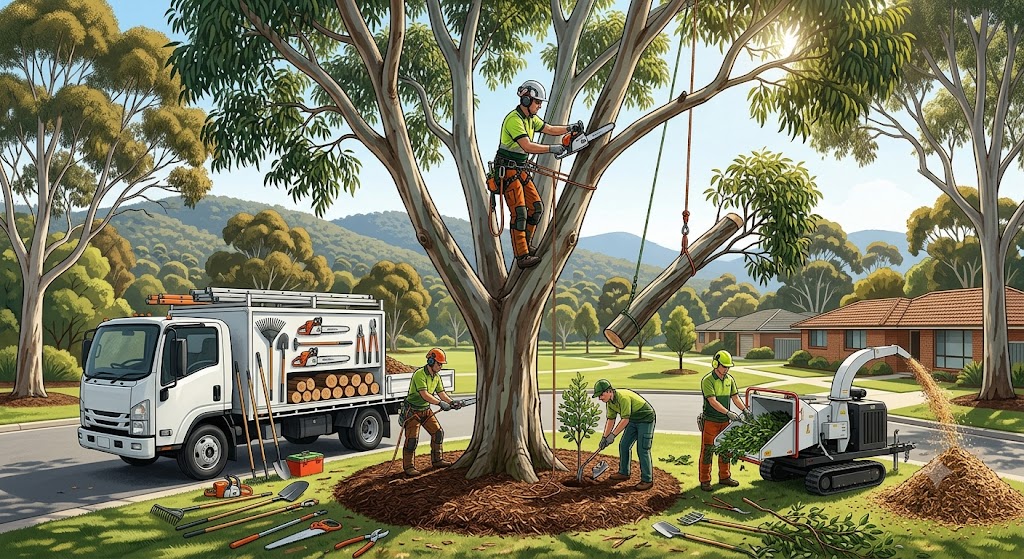
What Even Is an “Emergency Tree Service”?
Let’s be upfront: not every tree job is an emergency. But in Sydney’s suburban landscape — where 30-year-old eucalyptus trees grow 10 metres from a bedroom window and Jacarandas have quietly undermined every sandstone fence on the North Shore — the line between “scheduled maintenance” and “call someone now” can blur fast.
A genuine tree emergency usually involves one of the following:
Storm damage — Sydney’s east coast low-pressure systems are the stuff of legend. When they hit, branches don’t just snap cleanly. They shear, split, and land on roofs, driveways, fences, cars, and occasionally swimming pools. Storm damage tree removal in Sydney is the most common emergency callout, particularly across the Northern Beaches, North Shore, and the Hills District.
Fallen trees on structures — A tree that has already made contact with a building, powerline, or vehicle is a different beast entirely. It has to be removed in a specific order, using specific equipment, by people who understand load distribution and tree physics. It’s not a job for a bloke with a Husqvarna and a YouTube education.
Hazardous lean or root failure — Sometimes a tree doesn’t fall; it threatens to. A sudden lean after rain, a root system that’s clearly heaved, a trunk with a new and suspicious crack. These are emergency-level situations even without a dramatic collapse, because the collapse is what’s coming next.
Trees on powerlines — This one always requires immediate professional attention. Do not attempt anything yourself. Call Ausgrid if lines are involved, then call a certified arborist. The combination of electricity and a stressed tree is one of the few scenarios that genuinely has a zero-margin-for-error requirement.
At Sam’s Tree Services, they handle all of the above — across the North Shore, Northern Beaches, and broader Sydney region. But let’s talk about how proper emergency tree work actually happens, because the process matters as much as the response time.
How Emergency Tree Removal in Sydney Actually Works (Step by Step)
Here’s what separates a qualified local arborist from someone who just rocks up with a ute and a ladder.
Step 1: Rapid Risk Assessment
The first thing any competent arborist does when they arrive at an emergency scene is stop and look. Not at the tree — at the whole site. Where is the crown loading? Is there a secondary failure point? Are there utilities within the drop zone? Is the root plate still intact or has the tree already begun to pull?
This isn’t slow. A trained eye does this in 90 seconds. But skipping it is how people get seriously hurt.
Step 2: Site Securing and Exclusion Zones
Before any cutting begins, the area is cleared. Bystanders, vehicles, and pets need to be outside the work zone. For urban removals — especially in tight North Shore blocks where houses are practically touching — this step is non-negotiable and requires someone who knows what they’re doing.
Step 3: Selecting the Right Method
This is where specialist arboriculture knowledge pays off. Smaller emergency jobs might involve aerial work and sectional dismantling — the arborist climbs or uses an elevated work platform (EWP) and removes the tree in pieces, guiding each section down with ropes and rigging.
Larger jobs — or jobs where access is restricted, the tree is extremely tall, or the structure underneath is fragile — require a crane.
Step 4: Crane-Assisted Removal (When Standard Methods Don’t Cut It)
This is where things get genuinely impressive to watch. Sydney has some very large trees in very awkward positions. A 25-metre Sydney Blue Gum leaning toward a two-storey home in Wahroonga isn’t coming down in pieces with a rope and a prayer. It needs a crane.
The crane and tower specialists at Sam’s use cranes precisely for these scenarios — controlled lifts that remove entire sections or whole trees in a single movement, with none of the lateral force that would push a failing tree further into whatever it’s already resting on. Emergency crane tree removal in Sydney is a specialised skill set, not just “bring a crane.” The rigging, the communication between the crane operator and the arborist, the lift angles — all of it matters.
Step 5: Clean-Up and Site Restoration
Removing the tree is actually the faster part of the job. Chipping branches, clearing debris, grinding stumps, and leaving the site in a state that doesn’t look like a war zone takes time — but it’s part of what a professional tree service delivers. Not a pile of logs and a promise to come back sometime.
Why You Actually Need a Certified Arborist (Not Just Anyone With a Chainsaw)
This comes up constantly in online forums and neighbourhood Facebook groups, so let’s settle it: yes, there’s a difference between a certified arborist and someone who does “tree work.”
A certified arborist in Sydney has completed formal qualifications in arboriculture — understanding tree biology, failure mechanics, risk assessment, root systems, disease identification, and safe work practices. They understand how different species behave when stressed, which matters because a Eucalyptus doesn’t fail the same way a Liquidambar does, and a waterlogged Brush Box in Mosman is a very different removal from a dry-weather Cypress on the Central Coast.
The experienced arborists at Sam’s bring this kind of knowledge to every job — not just the big commercial ones, but the residential callouts where someone’s outdoor furniture is currently under a branch and they need help today.
Beyond the skill question, there’s also the insurance question. If an uncertified operator removes a tree and causes damage, your property insurer is going to ask some pointed questions about who authorised the work and whether they held the right qualifications. This is a headache nobody needs on top of storm damage.
Large-Scale Tree Services in Sydney: A Different Conversation Entirely
Residential emergency work is one thing. But Sydney has no shortage of large-scale tree projects — commercial precincts, strata complexes, council land, development sites, industrial properties — where the scope of work is categorically different.
Commercial property tree services involve a different level of planning, equipment, and documentation. We’re talking about:
- Multiple trees removed in coordinated sequences to protect surrounding infrastructure
- Council permit coordination and arborist report preparation
- Traffic management for streetside works
- Clearing to specific survey boundaries on development sites
- Ongoing maintenance contracts for strata and commercial bodies
For any site where trees are large, numerous, or located in constrained access areas, crane-assisted removal becomes the standard approach rather than the exception. A 30-metre crane with a grapple saw can process large-scale removals far more efficiently than traditional climbing methods — and with significantly less risk to surrounding structures.
If you’re a property manager, builder, strata manager, or business owner dealing with trees at scale, the conversation you need to have is with a team that regularly operates cranes and elevated work platforms — not a residential-focused operator who occasionally hires equipment.
Have a look at what Sam’s has delivered on commercial and large-scale projects — it’s a pretty good indication of capability before you even pick up the phone.
The Sydney Tree Law Bit (Because It Matters More Than You Think)
Look, nobody reads council planning documents for fun. But ignoring Sydney’s tree preservation framework is genuinely expensive, so here’s the short version.
Most councils in the Greater Sydney region have Tree Preservation Orders (TPOs) or Development Control Plans (DCPs) that regulate what you can and can’t do to trees on private property above certain height and trunk diameter thresholds. In many cases, removing or significantly pruning a tree without a permit is an offence — and the fines aren’t trivial.
The exception is genuine emergency work — if a tree has already fallen, is actively failing, or poses an immediate threat to life or property, emergency works can proceed. But you still need documentation. A qualified arborist can provide an emergency arborist report that demonstrates the work was necessary and justified. This matters for your insurance claim, and it matters if a council inspector asks questions later.
This is another reason why the “guy from Gumtree with a chainsaw” option is genuinely risky. Not just physically. Legally and financially too.
What to Do When a Tree Emergency Happens: A Practical Checklist
Because when it’s 2am and a tree has just landed somewhere it shouldn’t be, nobody wants to read an essay.
Immediate steps:
- Get everyone away from the affected area — people, pets, the lot
- If any powerlines are involved, call Ausgrid on 13 13 88 before anything else
- If there’s structural damage to the building, call your insurer and document everything with photos before anything is moved
- Call a qualified arborist for emergency tree removal — have a number saved before you need it
Don’t:
- Try to cut or move the tree yourself unless you have formal training and the right PPE
- Assume the “stable-looking” part is actually stable
- Wait until morning if the situation is actively dangerous
Do:
- Take photos and video of the tree and any damage for your insurance claim
- Note the time the damage occurred (insurers ask)
- Keep children and animals indoors until the site is cleared
The team at Sam’s Tree Services operates across the North Shore and Northern Beaches with rapid response capability. Saving the number now — 0412 733 877 — takes about five seconds. Using it in the middle of a crisis without having to search for it is a significantly better experience.
Why Local Arborist Expertise Actually Matters in Sydney
There’s a reason why the phrase “local arborist Sydney” carries weight beyond just geography. Sydney’s urban tree canopy is genuinely unique. You’ve got:
- Native species with specific structural characteristics and council protections
- A coastline that means salt-laden winds accelerate deterioration in canopy trees near the beach
- Sandy, clay, or shale substrates depending on where you are, all of which affect root system behaviour
- Fire risk zones in the western suburbs and fringe areas with specific vegetation management requirements
- Tight suburban blocks where tree-to-structure proximity is extreme
An arborist who has spent years working specifically in Sydney — who knows how a spotted gum behaves in Wahroonga versus how a Brush Box behaves in Manly — is worth considerably more than a general trades operator who occasionally does tree work.
Sam’s Tree Services has built its reputation specifically in the North Shore and Northern Beaches — the suburban corridors where tree density, heritage overlays, and tight block sizes create the most complex arboricultural challenges in the city.
The Benefits of Getting Tree Work Right (Not Just Getting It Done)
Let’s end on something practical: why investing in proper tree services pays off.
Safety — obviously. A hazardous tree that’s professionally assessed and removed is a risk that no longer exists. The “she’ll be right” approach to a leaning tree has ended badly enough times that it’s not worth revisiting.
Property value. Trees are assets when they’re healthy and well-maintained. A well-pruned, structurally sound garden tree adds value to a Sydney property. A neglected, over-grown, or dangerous tree is a liability — both financial and practical.
Insurance compliance. Many insurers now ask whether known hazardous trees were addressed prior to a storm event. If you’ve had a tree assessed, documented, and properly managed, you’re in a much stronger position when making a claim.
Neighbour relations. Nothing causes more North Shore neighbour disputes than trees — specifically, when branches overhang fences, roots crack driveways, or a neglected tree from one property causes damage to another. Staying ahead of these issues through regular arboriculture maintenance is genuinely cheaper and less stressful than managing the fallout.
The garden actually looks good. Tree work done properly — deadwooding, formative pruning, crown reduction — transforms a chaotic overgrown backyard into something you actually want to spend time in.
Ready to Talk to Someone Who Knows Their Stuff?
Whether you’ve got a tree down right now, a suspicious lean you’ve been meaning to get looked at, or a commercial property that needs a full canopy management plan — get in touch with Sam’s Tree Services.
They cover the North Shore and Northern Beaches with a team that brings genuine qualifications, proper equipment (including crane capability for the jobs that need it), and a no-nonsense approach to getting trees sorted properly.
Browse the full range of services here, or check out completed projects for a realistic look at the kind of work they do.
Trees are brilliant until they’re not. When they’re not, call people who handle this stuff every day.